Frequently confused in recycling plants, these two machines differ significantly in working principle, application and the type of material they suit. The right choice affects both your investment cost and your line efficiency.
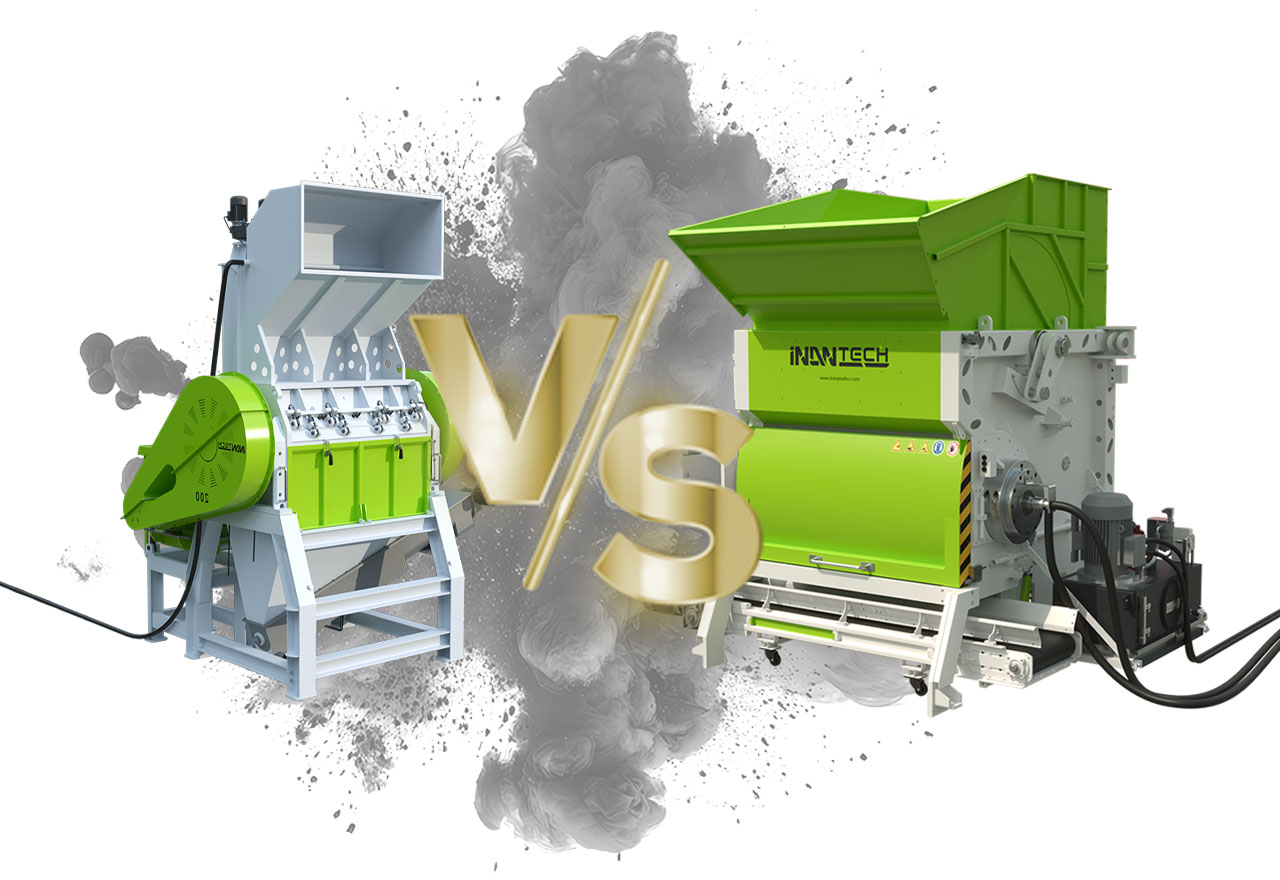
A plastic crusher is a size-reduction machine that works on a cutting principle, between high-speed rotating rotor blades and fixed blades. It turns plastic material into homogeneous particles according to a given screen size; the output size is controlled by changing the screen.
It delivers the highest efficiency on thin-walled, regularly shaped plastics. Because it can be integrated in-line into the production line, scrap can be recovered without any downtime.
A shredder applies primary size reduction to bulky, thick-walled or baled plastic waste on a low-speed, high-torque principle. Low speed combined with high force allows tough materials to be broken down. It is produced in single-shaft or twin-shaft designs; twin-shaft models give more reliable performance on resistant, high-volume material.
Compared with crushers, the output size is coarser and more heterogeneous, which is why a shredder is often combined with a crusher to form a sequential line.
The choice comes down to three core questions: the wall thickness and volume of the material (thin film / small parts → crusher; thick / baled → shredder first), the need for in-line integration (instant scrap recovery → crusher) and the final output size (a homogeneous, screen-controlled size for extruder feeding → crusher).
In most plants the two machines form a complementary sequential line: shredder → crusher → washing → extrusion.
Are a crusher and a granulator the same thing? In the industry the terms are mostly used interchangeably; technically, a granulator is a crusher that provides homogeneous size control through a screen system.
Can a shredder replace a crusher? No. A shredder performs primary size reduction and its output is not homogeneous; in processes that require a precise size it must be supported by a crusher.
Tell us your material and your goal; we will decide together whether it is a crusher or a shredder.
