Choosing an inline granulator for a thermoforming line: skeleton width, material, line speed and where the regrind goes. A practical guide.
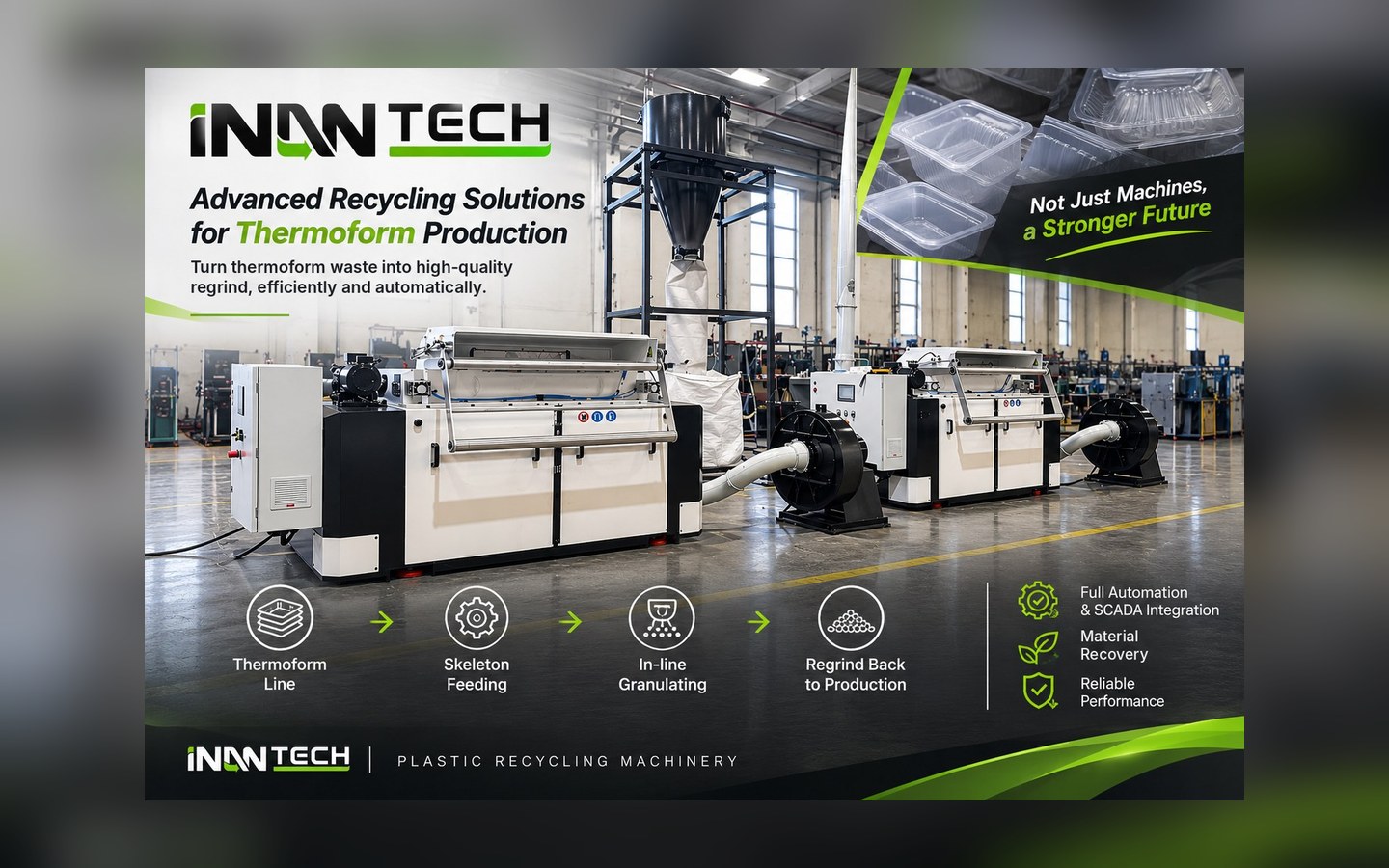
When a thermoforming machine forms cups, containers or trays from sheet, a skeletal waste is left behind. This waste can be collected and ground later in a separate granulator, but that takes space, labour and time. An inline granulator, also called an in-line crusher, is placed directly after the thermoforming machine. The skeleton is pulled in and ground as soon as it leaves the machine. The regrind can then go back into sheet production on the extrusion side. Waste does not pile up, the production area stays tidy and raw material losses go down.
Choosing an inline granulator is not only about the power of the machine. It has to work in step with your line. The four questions below are the shortest way to the right model.
The granulator's inlet must be wide enough for the skeleton to enter without folding or jamming. If the skeleton is wide and the machine is too narrow, the waste folds during feeding, which leads to uneven regrind and stoppages. So the first thing to check is the sheet and skeleton width of your thermoforming machine. A wider skeleton calls for the larger models in the range.
Thermoforming materials such as PP, PS and PET behave differently. Some are more brittle, others more flexible. The material affects the knife design, the screen choice and the amount of fines in the regrind. If you plan to use the regrind again in sheet production, a uniform regrind with little dust is especially important. Telling us your material at the start lets us configure the machine for it.
The inline granulator has to keep pace with the thermoforming machine. As the line speeds up, more skeleton enters the granulator per unit of time. If the granulator is not sized for the line's top speed, it becomes the bottleneck. Cycle time and sheet thickness are the key inputs for this calculation.
How the regrind is conveyed after the granulator also affects the choice. It can be collected directly, or conveyed by a fan and cyclone to a silo or a big bag. The conveying method determines the machine's layout and the supporting equipment. Sharing your line layout helps us work out the right solution together.
The 38.125 is the largest inline granulator we build for thermoforming lines. It is designed for lines that produce a wide skeleton. For lines that run narrower sheet or produce at lower speeds, the 27.30, 28.80, 32.40, 38.60 or 38.100 models in the range may be a better fit. We confirm the right model together with you, based on your skeleton width and line data.
Yes. An inline pull-in and feeding system can also be fitted to our granulators outside the inline range. This gives you a wider choice of models for your line. If you plan to add a granulator to an existing line, the machine's position and feeding direction should be planned together from the start.
An inline granulator works as part of the thermoforming line, so it needs to start and stop in step with the rest of the line. On request, we connect the machine to the line's automation and integrate it into the SCADA system. The machine's status can then be monitored from the line's control screen.
To recommend the right model, we need:
Technical information may vary; for precise details, please contact İnan Tech.
Share your thermoforming line details and our team will recommend a suitable model.
